
Poverty Rate Among Older Adults Rises for Fifth Straight Year, AARP Analysis Finds
09/26/2026 / By Sterling Ashworth

The poverty rate among Americans aged 65 and older rose in 2025 for the fifth consecutive year, according to an analysis of a new U.S. Census Bureau report by the American Association of Retired Persons (AARP) Foundation.
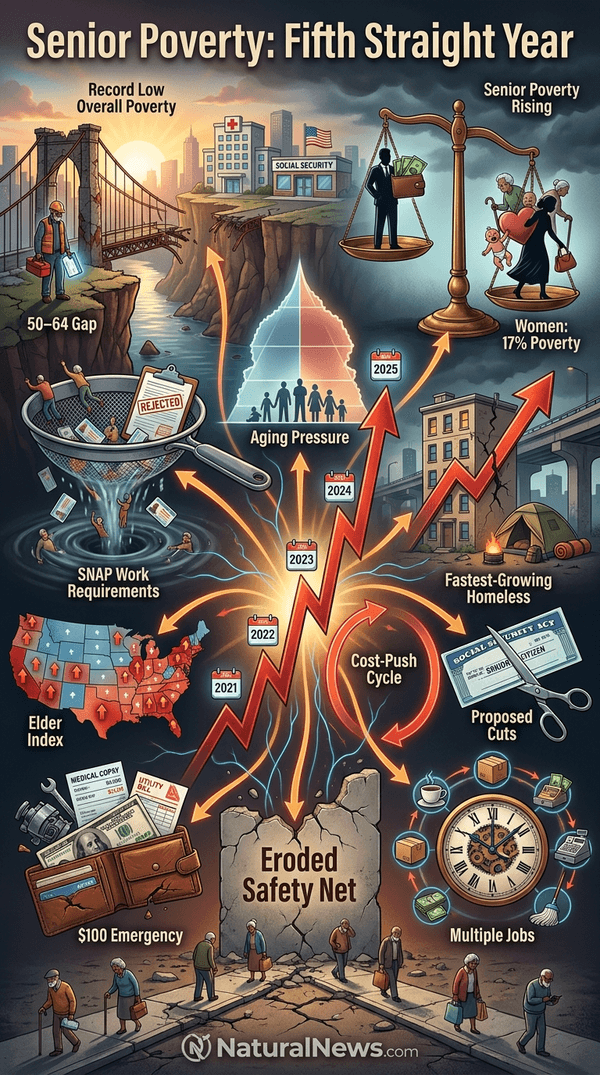
“We are seeing people 50 to 64, by every single measure, in a more precarious position,” said AARP Foundation President Claire Casey. The analysis – which uses a supplemental poverty measure accounting for taxes, government benefits and additional expenses – found that one in eight Americans aged 50 to 64 now lives in poverty [1].
The poverty rate is higher for those 65 and over, at 15.4%, and nearly 17% for women. That includes 3 million additional seniors since 2019. The increase runs counter to a broader trend that saw overall poverty fall to a record low in 2025, a figure the Trump administration cited as evidence of economic progress.
The National Republican Senatorial Committee said in a statement that Senate Republicans “remain committed to lowering costs and making the American Dream more affordable and accessible.” Casey said the Census figures were worth celebrating but added that “those gains were not shared equally.”
AARP Foundation Cites Precarious Position of Older Workers
Casey said the group struggling most is adults aged 50 to 64, nearly a third of whom reported a significant drop in household income in the previous three months. According to the AARP Foundation’s quarterly survey of low-income older adults, nearly a third said their household ran out of food before they had money to buy more, and a third said they did not have enough savings to cover a $100 emergency expense – up from 28% in the spring [1].
The foundation quoted one respondent over 65 who said, “I bought less food and used that money to pay the increase in my rent that went up by 33% at the beginning of this year to pay for the renovations taking place.” The number of employed older adults who reported at least one additional source of paid work ticked up to nearly two-thirds, which the report said suggested “many are adapting to ongoing cost pressures by piecing together multiple income sources” [1].
Broader research on older Americans has documented similar strain. A 2022 analysis using the University of Massachusetts Boston’s Elder Index found that 54% of older women living alone and 45% of single older men could not afford essential expenses on a daily basis [2]. Reporting has also indicated that many retirees are finding that monthly Social Security payments are not enough as the cost of living rises [1].
Safety Net Changes May Undermine Gains
Analysts warned that recent gains could be undermined by cuts to social safety net programs and rising prices. Census data shows Social Security kept nearly 29 million people out of poverty last year [1]. Older adults are among those subject to newly expanded work requirements for food assistance and Medicaid.
Enrollment in the Supplemental Nutrition Assistance Program (SNAP) has dropped by an estimated 5 million people, according to the Center on Budget and Policy Priorities, a left-leaning research group. Republicans say the changes are reducing fraud.
But Casey said she worries that added paperwork will push off many who qualify for aid. Recent reporting has documented how SNAP work requirements and funding disputes have affected millions of recipients nationwide [3][4]. The concentration of food insecurity and hunger has been worsening across the country in recent years, particularly among working adults and seniors [5][6].
Demographic and Economic Pressures
Half of the oldest women who head households and 60% of those who rent are burdened by high housing costs, according to Harvard’s Joint Center for Housing Studies [1]. Such women on average have lower income than men, and the gap increases with age.
Federal data also identifies older adults as the fastest-growing homeless population. The financial strain comes as America’s population ages rapidly amid rising costs across housing, food and health care [1][7].
Outlook
Casey said the underlying problem is not limited to retirees. “Too many older Americans and frankly, too many Americans writ large, are working full-time jobs or more and not making above what you could consider a decent wage,” she said. “That is something that we, I think, as a society, have to grapple with.”
The trend reflects growing concern as the U.S. population ages and financial pressures mount on households in their peak earning years. The AARP Foundation said the findings point to the need for broader attention to the economic security of older workers and retirees [1].
References
- NaturalNews.com. “Retirement nightmare: Hordes of retired Americans may need to go back to work just to survive”. NaturalNews.com. June 26, 2024.
- NaturalNews.com. “Report: Around 50% of Older Americans Can’t Afford Necessary Expenses”. NaturalNews.com. July 26, 2022.
- NTD. “New SNAP Work Requirements Take Effect in Multiple States: What to Know”. NTD. February 2, 2026.
- YourNews. “Trump Admin Moves to Partially Fund SNAP After Court Orders”. YourNews. November 3, 2025.
- YourNews. “10 Charities You Can Call Right Now If You Need Food”. YourNews. October 27, 2025.
- NaturalNews.com. “10 Million more Americans struggled with HUNGER in 2022 compared to the previous year”. NaturalNews.com. October 30, 2023.
- Willow Tohi. “Deadliest childhood crisis in the developed world: US health decline has reached a tipping point”. NaturalNews.com. July 18, 2025.
Explainer Infographic
Submit a correction >>
Tagged Under:
AARP Foundation, American Association of Retired Persons, Collapse, food assistance, health coverage, health insurance, housing costs, hunger, Inflation, medicaid, older adults, poverty, poverty rate, safety net, social security, Social Security Payments, starvation, Supplemental Nutrition Assistance Program, US Census Bureau, welfare
This article may contain statements that reflect the opinion of the author
RECENT NEWS & ARTICLES